
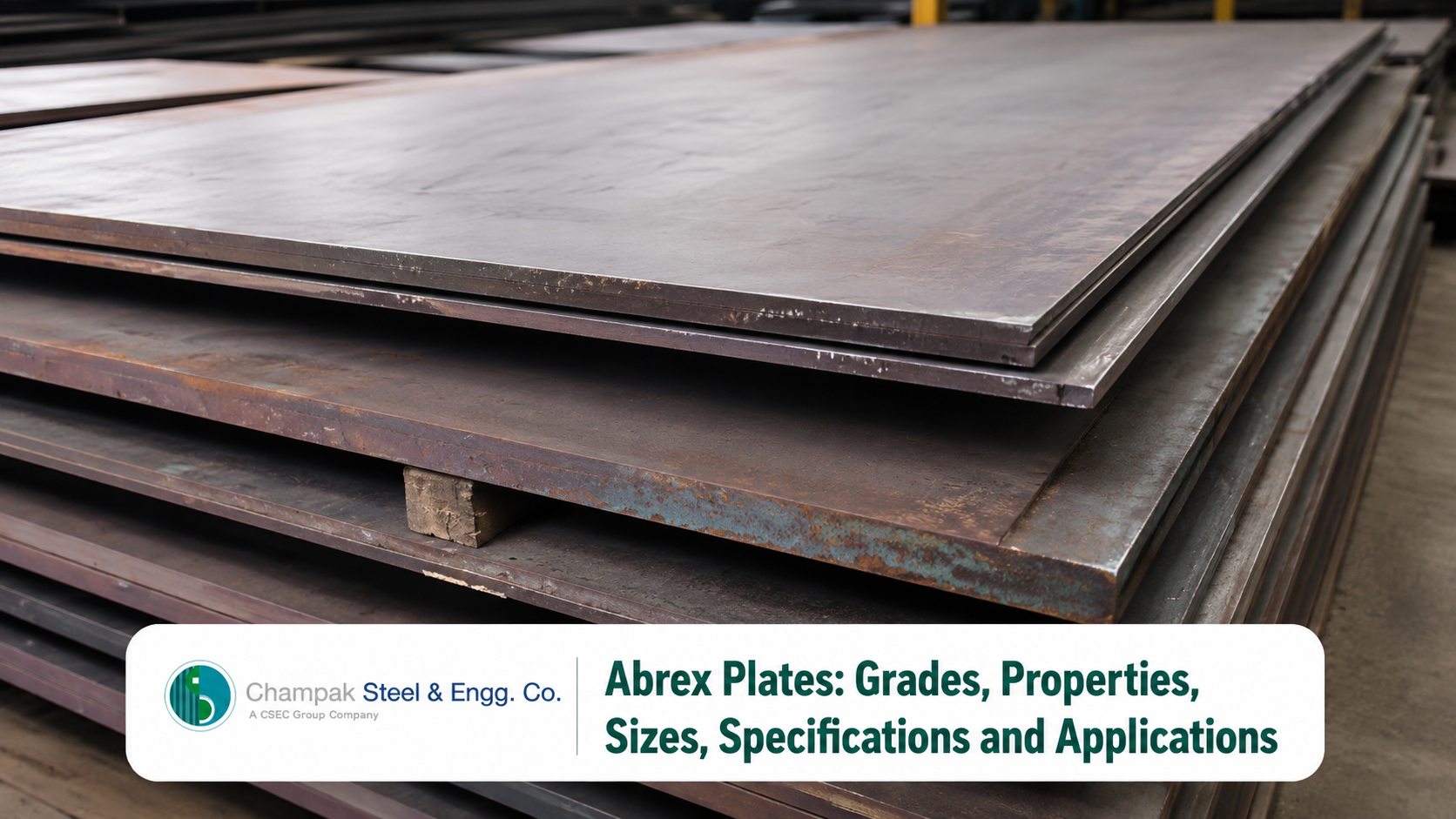
Heavy equipment used in crushing, screening, and bulk material transfer deteriorates quickly when its contact surfaces are made from ordinary structural steel. Abrex plates resist that constant friction so you don’t have to replace them as often. A plate that is hard but brittle cracks under impact, so toughness must be built in along with hardness. ABREX 400 is the grade most frequently specified for wear-intensive service and offers a practical starting point for the wider Abrex range. This article covers the grades, properties, sizes, specifications, and applications of Abrex plates.
What Are Abrex Plates?
Abrex plates are quenched and tempered steel plates designed to resist surface wear in equipment that handles abrasive material. Their purpose is to protect the structural steel beneath a wear surface so the component lasts longer between repairs. Abrasion resistance matters particularly when metal-to-material contact is constant, since raw mild steel loses thickness fast under continuous rock or ore contact. Push hardness too high without enough toughness, and the plate cracks under impact; keep toughness high without enough hardness, and it breaks too fast. Mining, quarrying, cement, construction, and recycling operations require balance daily, and properly fitting into a wear zone can extend component service life beyond that of a standard plate.
Abrex Plate Grades
ABREX 400
ABREX 400 is a 400-class abrasion-resistant steel with a nominal Brinell hardness rating of 400 HBW. Through-hardening during manufacture delivers a hardness near 415 BHN when used, making it one of the most commonly used wear types on the market. The plate combines that strength with enough impact toughness to survive strikes from falling rock and tramp metal without cracking immediately. Fabricators still cut, drill, and weld it with standard workshop equipment, keeping it practical for liner fabrication. Common heavy-duty applications involve dump truck beds, crusher liners, chute linings, and bucket wear plates, wherever sliding or impact abrasion is a daily condition. Buyers can review current stock and sizes on the ABREX 400 plate page.
Other Abrex Grade Options
Abrex plates are available in different hardness classes, including ABREX 450 Plates and ABREX 500 Plates, depending on the required abrasion resistance, impact strength and operating conditions. Abrasion severity, the presence of impact loading, plate thickness, and planned fabrication methods all influence which class fits a given application. A liner exposed mainly to light sliding wear can perform well at a lower hardness class, while equipment absorbing repeated heavy impact needs enough toughness to avoid cracking, even at a marginally lower surface hardness. Confirm the exact class and its documented hardness range with the supplier before specifying it, since available thicknesses vary between manufacturers.
Key Properties of Abrex Plates
High abrasion resistance is the defining property of Abrex plates. The martensitic microstructure formed during quenching resists the gouging and scratching that wears down softer steel far faster. Hardness delivers that resistance, but toughness keeps a hardened plate in service instead of cracking on first heavy impact, which matters directly in crusher and hopper linings where falling material strikes rather than slides. High strength adds a structural benefit beyond wear resistance, letting fabricators use thinner sections for the same load capacity. Weldability remains a practical concern too: Abrex plates can be cut, drilled, and welded with standard equipment, provided preheat and welding procedures suited to hardened steel are followed. Together, these properties add up to a longer service life and fewer liner change-outs.
Abrex Plate Sizes and Thicknesses
Available sizes and thicknesses vary by manufacturer and by grade, so no single range applies across every Abrex class. Thickness selection depends on how much material loss a plate needs to absorb over its service life and how much structural support the component requires beyond wear resistance. A thin liner suits light sliding wear; heavy impact zones need enough thickness to allow gradual material loss without exposing the structure underneath. Length and width affect fabrication too, since larger sheets reduce the number of welded joints in a liner. Dimensional tolerances matter for fit-up during welding. Confirm exact dimensions and tolerances with project requirements before finalising a cutting plan.
| Size Consideration | Why It Matters |
| Thickness | Determines wear allowance and structural suitability |
| Width | Must suit equipment and fabrication requirements |
| Length | Influences cutting and fabrication efficiency |
| Tolerance | Ensures dimensional compatibility |
Abrex Plate Specifications and Standards
Verifying the exact grade and specification before ordering prevents mismatches between what a project needs and what arrives on site. Chemical composition and mechanical properties, including yield strength and elongation, apply where the fabrication process or the application demands them. Material Test Certificates confirm that a specific batch meets its stated hardness and mechanical properties, and requesting one with every order is standard industrial practice. Material identification and full batch traceability back to the mill matter just as much, particularly where certification records are needed later for audits or warranty claims.
Advantages of Using Abrex Plates
Abrex plates resist abrasive wear far better than mild or standard structural steel exposed to the same conditions, which is the primary reason operations specify them. That resistance translates into longer service life for liners, chutes, and buckets in continuous contact with rock, ore, or sand. Fewer wear failures mean fewer unplanned shutdowns to swap a liner mid-shift. Heavy-duty equipment in mining, construction, and material handling benefits most, since these are the operations where replacement costs and downtime add up fastest. The hardness-toughness balance built into Abrex steel means plates survive impact loading rather than cracking on first contact, and over a full maintenance cycle this feature can reduce replacement frequency and associated downtime.
Applications of Abrex Plates
Mining and Quarrying
Mining machinery exposed to constant rock and ore contact relies on Abrex plates in crushers, where the liner absorbs both impact from falling material and sliding wear as ore moves through. Chutes see similar sliding abrasion, and bucket and liner wear surfaces on excavation equipment take direct abrasive contact hour after hour.
Construction Equipment
Excavators and loaders working with abrasive soil, gravel, or demolition debris put continuous stress on bucket edges and cutting surfaces. Dump bodies carrying loose rock wear from the inside out with every load cycle, and wear-prone components across construction machinery benefit from the same hardness-toughness balance.
Cement and Material Handling
Hoppers holding clinker or aggregate experience sliding and impact wear at the discharge point. Conveyors moving abrasive bulk material wear along the full chute length, bins wear at the outlet, and transfer systems face the same combination of impact and sliding contact throughout a plant.
Recycling and Waste Processing
Shredders processing metal or mixed scrap put Abrex plates through demanding impact conditions, since shredded material strikes wear surfaces directly. Containers holding crushed material take abrasive wear at the base and walls, and processing equipment throughout a recycling line benefits for the same reason.
Abrex Plates vs Conventional Steel Plates
Abrasion resistance is where Abrex plates separate clearly from conventional structural steel. Standard mild steel offers no engineered resistance to surface wear, so it loses thickness fast under abrasive contact, while Abrex plates are hardened specifically to resist that wear. Hardness tells much of the story: conventional steel plate hardness sits well below 200 BHN, compared to Abrex grades starting around 400 BHN and rising with the class selected. That gap shows up directly in wear life, with Abrex plates lasting substantially longer in genuinely abrasive service. Heavy-duty use is where Abrex plates earn their higher upfront cost; conventional steel remains suitable where wear exposure is minimal, and maintenance costs fall with Abrex plates once the grade is matched correctly to the application.
| Feature | Abrex Plates | Conventional Steel Plates |
| Abrasion Resistance | High | Generally lower |
| Hardness | Higher | Generally lower |
| Wear Life | Longer in abrasive service | Generally shorter |
| Heavy-Duty Use | Highly suitable | Application-dependent |
| Maintenance | Potentially reduced | Potentially higher |
How to Select the Right Abrex Plate
Start by identifying the type and severity of abrasion the component will face: sliding contact wears differently from gouging or high-velocity impact, and each favours a different hardness-toughness balance. Impact loading needs separate consideration from steady sliding wear, as a grade optimised purely for hardness can crack under repeated heavy strikes. Thickness and dimensions are determined by the structural and wear-allowance requirements of the component. Welding and fabrication requirements narrow the choice further, since some grades need specific preheat procedures to avoid cracking in the heat-affected zone. Operating conditions, including temperature, factor into the decision too. Before ordering, verify grade, specification, certification, and traceability with the supplier, then confirm the plate matches the equipment design.
Conclusion
Abrex plates deliver measurable abrasion resistance, hardness, and toughness across grades built for wear-intensive service, from mining liners to construction wear parts and cement handling equipment. Correct sizing matters as much as grade choice, since an undersized plate wears through regardless of how hard the steel is. Matching hardness and thickness to the actual service condition, rather than the highest number on a datasheet, determines whether a liner lasts a full maintenance cycle. ABREX 400 remains a practical starting point for most moderate-to-severe wear applications. Confirm technical specifications and Material Test Certificates with the supplier before finalising material selection, and review current stock on the ABREX 400 plate page.