
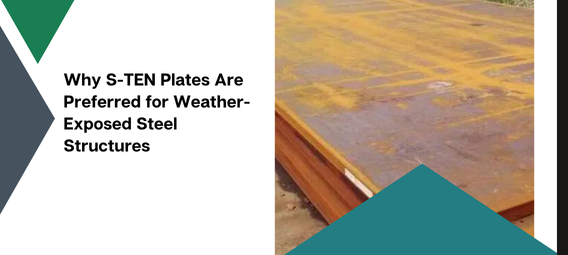
S-TEN plates prevent outdoor structure deterioration by resisting atmospheric corrosion without requiring immediate protective coatings. Standard carbon steel is subject to corrosion when exposed to extended moisture, industrial pollutants and temperature cycling, which results in costly maintenance cycles and reduces the life of the structure. S-TEN plates tackle this issue head-on: corrosion-resistant structural steel plates designed to function in harsh atmospheric and industrial environments where traditional grades fail prematurely.
What Are S-TEN Plates?
S-TEN plates are low-alloy, high-strength corrosion-resistant steel plates developed to withstand atmospheric attack in outdoor industrial environments. Their alloy composition, incorporating copper, chromium, phosphorus, and nickel additions, forms a stable oxide layer on the surface when exposed to cyclic wetting and drying. This patina adheres tightly to the base metal, slowing further corrosion rather than flaking off as conventional rust does on plain carbon steel.
Reputable S-TEN Plate Exporter worth evaluating supplies plates that deliver tensile strengths from 480 MPa to 610 MPa alongside atmospheric corrosion resistance 4–8 times greater than standard IS 2062 carbon steel in comparable exposure conditions. Weldability meets structural fabrication requirements across standard MIG, TIG, and submerged arc welding procedures without mandatory preheat below 20 mm thickness.
Challenges Faced by Weather-Exposed Steel Structures
Rain, condensation, industrial gas emissions, and coastal salt spray attack unprotected steel surfaces simultaneously and the damage compounds. Each wet-dry cycle drives corrosion deeper into the base metal, thinning wall sections and reducing load-carrying capacity over time. Structures exposed to sulfur dioxide emissions from industrial stacks corrode 3–5 times faster than those in clean rural atmospheres.
Conventional carbon steel structures in industrial environments typically require repainting every 5–7 years to maintain surface protection. Sandblasting, priming, and topcoat application on large structures, chimneys, flue ducts, and outdoor frameworks run to significant project costs each maintenance cycle. Structural integrity loss from unchecked corrosion adds inspection costs and potential load restriction requirements on top of routine maintenance expenditure.
Why S-TEN Plates Are Preferred for Weather-Exposed Steel Structures
Excellent Atmospheric Corrosion Resistance
S-TEN plates resist atmospheric corrosion at 4–8 times the rate of standard carbon steel in industrial and semi-industrial environments. The stable oxide layer that forms during initial weathering acts as a self-regenerating barrier; unlike paint coatings, it does not peel, crack, or require reapplication. This characteristic makes S-TEN the practical material choice for structures where access for maintenance repainting is restricted or costly.
Resistance to Industrial Pollutants
Sulfur dioxide, nitrogen oxides, and chloride particles common in industrial zones and coastal industrial sites attack plain carbon steel aggressively. The phosphorus and copper in S-TEN form a thicker, more stable oxide that sulphurous chemicals can’t penetrate. This resistance provides an immediate advantage to buildings adjacent to power plants, chemical processing plants and coastal industrial estates, keeping corrosion rates at a lower level with no further surface treatment necessary.
High Strength and Structural Reliability
Minimum yield strength of 355 MPa and tensile strength of up to 610 MPa enable engineers to specify thinner sections than equivalent plain carbon steel grades, reducing structure weight without compromising on load capacity. The Charpy impact values are still acceptable to -20°C, demonstrating the viability for outdoor buildings in regions with winter temperature reductions.
Excellent Weldability and Fabrication
S-TEN plates cut cleanly on plasma and oxy-fuel equipment with kerf and heat-affected zone characteristics comparable to IS 2062 E350. Standard MIG and submerged arc procedures apply without mandatory preheat for thicknesses up to 20 mm, reducing fabrication time and energy cost. Post-weld heat treatment is not required for most structural connections.
Lower Maintenance and Lifecycle Costs
Eliminating 5-yearly repainting cycles on a large industrial chimney or outdoor steel framework saves 15–25% of total asset lifecycle cost over a 25-year service period. S-TEN structures in continuously exposed service typically require only periodic inspection rather than active surface restoration a shift from scheduled cost to condition-based maintenance that benefits project operators managing multiple assets across a site.
Ideal for Long-Term Outdoor Applications
Outdoor steel frameworks exposed to seasonal monsoon, winter frost, and high-humidity coastal conditions demand material that performs across the full annual weather cycle not just in dry conditions. As an established S-TEN Plates Supplier in Mumbai, Champak Steel & Engg. Co. supplies plates to infrastructure and industrial projects across India’s coastal and industrial belt where this full-cycle atmospheric performance is a specification requirement, not an optional upgrade.
Common Applications of S-TEN Plates
Industrial chimneys and flue gas systems represent the most established application continuous exposure to combustion gases, condensed sulfurous acids, and external atmospheric moisture creates conditions that consume standard carbon steel within 8–12 years. S-TEN extends service life to 25 years and beyond in comparable conditions.
Power plant structures, outdoor equipment housings, and chemical processing plant frameworks use S-TEN where painting access is restricted and maintenance shutdowns carry high production cost. Waste treatment facility structures, industrial ducts handling corrosive gas streams, outdoor infrastructure bridges and walkways, and material handling gantries in mining and port environments all draw on S-TEN’s combination of strength and atmospheric resistance to reduce lifecycle maintenance requirements.
How to Choose the Right S-TEN Plate Supplier
Start with standards compliance confirmation: S-TEN plates follow JIS G3125 SPA-H specifications, and suppliers should provide documentation confirming compliance rather than verbal assurances. Request Material Test Certificates covering chemical composition, mechanical properties, and impact test results before placing the purchase order.
Check available plate dimensions against your project schedule. Standard commercial stock runs from 5 mm to 50 mm thickness in widths up to 2,500 mm; projects requiring non-standard gauges need lead time confirmation at the inquiry stage. Evaluate the supplier’s logistics capability for domestic delivery and export dispatch. A capable S-TEN Plate Exporter handles documentation, packaging, and insurance for sea freight without requiring the buyer to manage third-party forwarding independently.
Conclusion
S-TEN plates outperform standard carbon steel in every atmospheric corrosion metric that matters for outdoor industrial structures: corrosion rate, maintenance frequency, service life, and total lifecycle cost. The material’s weldability and structural strength make it a direct substitution for IS 2062 E350 in most outdoor applications, without the penalty of complex fabrication procedures.
Champak Steel & Engg. Co. stocks S-TEN plates with full JIS G3125 documentation and cut-to-size capability for both project and repeat orders. Speak with the team to confirm plate availability and dimensions before your next specification round.