
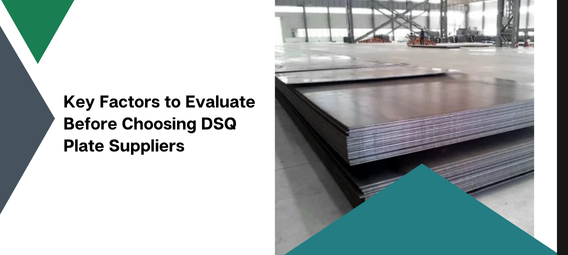
Evaluating DSQ plate suppliers requires vetting dimensional consistency, certified material testing, and punctual delivery to prevent costly fabrication delays. DSQ plate suppliers deliver cold-rolled structural steel plates valued for their formability, clean weldability, and consistent mechanical properties across gauges. Choosing the right supplier requires the same level of technical scrutiny as selecting the correct steel grade.
Why Choosing the Right DSQ Plate Supplier Matters
Product consistency depends entirely on supply chain discipline. A supplier holding steady inventory across thickness ranges can fulfil repeat orders to the same heat and mechanical spec, critical for fabricators producing structural components in batches where variation between plates shows up as fitment problems in the assembly bay.
Certified materials come with documentation that project engineers, quality auditors, and end clients demand before installation. Suppliers who treat test reports as optional extras rather than standard dispatch documents create downstream problems that take weeks to resolve. Expert DSQ plate makers know that technical help during procurement, grade clarification, thickness selection guidance, and compliance confirmation lowers errors before material reaches the shop floor, not after.
Key Factors to Evaluate Before Choosing DSQ Plate Suppliers
Product Quality and Material Standards
Confirm that plates meet IS 2062 or equivalent structural steel standards covering yield strength, tensile strength, and elongation at fracture. Chemical composition limits, particularly carbon equivalent values, determine weldability in fabrication. Suppliers who manufacture or stock consistently within specification reduce the rejection rates that inflate project costs on structural and pressure vessel work.
Manufacturing Experience and Industry Reputation
A DSQ plate manufacturer with documented experience across construction, infrastructure, and industrial fabrication markets carries institutional knowledge that newer entrants lack. Ask for project references in the same application category. Suppliers who have consistently delivered to large-scale structural projects understand tolerance requirements, documentation trails, and the coordination that fast-turnaround orders demand on active sites.
Material Certifications and Test Reports
Every plate shipment requires a Material Test Certificate covering chemical composition, mechanical test results, and heat number. Inspection reports confirm dimensional and surface quality before material leaves the mill or stockyard. Full traceability from heat number back to the original mill cast allows quality teams to isolate and address any field issue without pulling an entire batch from service.
Product Range and Customisation Options
Projects rarely fit standard commercial stock dimensions. Evaluate whether the supplier cuts to non-standard widths and lengths, and whether they hold a range from 5 mm through 100 mm thickness to cover both light fabrication and heavy structural sections. Suppliers with in-house cutting capability plasma, oxy-fuel, or waterjet deliver material closer to finished dimensions, reducing fabrication shop time and scrap.
Stock Availability and Delivery Capability
Ready stock availability separates suppliers who can support an urgent order from those who require 6–8 weeks on standard sections. Confirm what thicknesses and widths sit in the warehouse before placing time-critical orders. Packaging quality for sea freight and long-haul road transport also matters; plates that arrive with moisture damage or surface contamination require re-inspection and delay production regardless of lead time.
Technical Support and Customer Service
Grade selection between DSQ, IS 2062 E250, and IS 2062 E350 variants requires application context; operating temperature range, welding procedure, and surface treatment all affect the correct choice. Suppliers who assign technically qualified contacts to accounts answer these questions at the inquiry stage rather than after the purchase order. Responsive communication across procurement, dispatch, and after-delivery queries reduces the administrative overhead that procurement teams carry on multi-supplier projects.
Pricing and Overall Value
Price per kilogram tells only part of the procurement story. Plates supplied 10% below market rate without test certificates or with dimensional tolerance outside IS 2062 Class 1 limits cost more in rework and delay than the savings justify. Evaluate total cost, material price, certification completeness, delivery reliability, and the risk of project interruption before committing to the lowest-quoted option on a structural or industrial application.
Questions to Ask Before Finalising a DSQ Plate Supplier
Clear answers to six questions reveal supplier competence before the purchase order goes out.
- Can you provide Material Test Certificates and third-party inspection reports with every shipment?
- What thicknesses and widths do you hold in ready stock right now?
- Do your DSQ steel plates comply with IS 2062 or equivalent structural steel standards?
- What is your lead time for cut-to-size orders below 5 MT?
- Do you offer plasma or oxy-fuel cutting for non-standard dimensions?
- What packaging do you use for plates destined for sea freight or long-haul road transport?
Common Mistakes to Avoid When Choosing a Supplier
Selecting on price alone bypasses the certification and dimensional checks that determine whether material passes inspection on site. Ignoring test certificates during procurement means discovering missing documentation when the project auditor arrives, not when the purchase order goes out. Overlooking stock depth creates exposure to lead-time delays when a project accelerates, and urgent top-up orders cannot be fulfilled. Skipping technical verification means discovering that a supplier lacks the grade expertise to confirm carbon equivalent values for a specific welding procedure after delivery. Failing to confirm cut-to-size capability forces the fabrication shop to perform additional cutting on standard commercial lengths, adding both time and scrap cost.
Conclusion
The decision to procure DSQ plates is relevant beyond the material specification. Whether a project runs smoothly or suffers avoidable delays is a function of grade compliance, certification completeness, stock depth, delivery reliability, and technical support. Working with an experienced DSQ plate producer lessens the risk in procurement from grade confirmation through to shipment documentation.
Champak Steel & Engg. Co. stocks DSQ steel plates with complete MTC documentation and a cut-to-size facility for all standard as well as project-specific requirements. Please contact the team to check availability and lead times before placing your next order.