
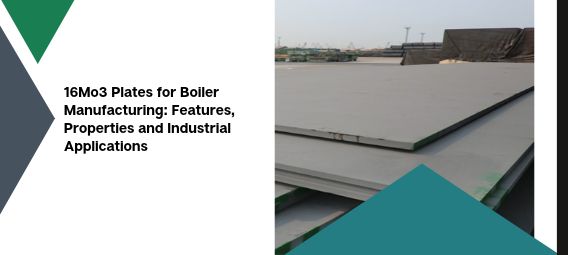
16Mo3 plates are molybdenum-alloyed steel plates supplied for pressure equipment functioning at elevated temperatures. Boiler manufacturers specify them where wall temperatures approach 500°C and the plate has to hold its strength rather than creep under sustained load. The 0.25 to 0.35% molybdenum addition does that work. Fabricators also favour the grade because it welds with established procedures, which keep drum and shell fabrication predictable across the full thickness range.
What Are 16Mo3 Plates?
16Mo3 is a low-alloy pressure vessel steel carrying material number 1.5415, classified under EN 10028-2 as an alloy steel with specified elevated-temperature properties. Carbon remains between 0.12 and 0.20%. Manganese ranges from 0.40 to 0.90%, and molybdenum from 0.25 to 0.35%. Mills supply the plate normalised, or quenched and tempered, where a project specifies that condition. The grade superseded the older DIN 17155 15Mo3 designation. In American practice, ASTM A204 16Mo3 alloy steel plates are cross-referenced against A204 Gr. B, although the two specifications sit close rather than identical, so the governing design code decides which one applies.
Key Features of 16Mo3 Plates
Five characteristics explain why boiler shops prefer this grade during selection. Each one affects fabrication cost as much as service performance.
- Strength at elevated temperature: Minimum yield holds at 159 MPa at 400°C for plates up to 16 mm thick, against 275 MPa at room temperature.
- High-temperature service capability: Continuous operation at wall temperatures near 530°C is established practice for this grade.
- Weldability under qualified procedures: Preheat and post-weld heat treatment, set by thickness and consumable, keep heat-affected-zone hardness inside code limits.
- Molybdenum-driven creep resistance: At 0.25 to 0.35%, molybdenum lifts creep rupture strength to roughly 167 MPa at 450°C over 100,000 hours.
- Thickness and dimensional availability: Mills roll the plate from about 5 mm up to 250 mm, with width and length varying by mill specification.
Chemical and Mechanical Properties of 16Mo3 Steel
Both tables list cast analysis limits and guaranteed minimums from EN 10028-2, with mechanical values split by thickness because yield and tensile figures fall as the plate gets heavier.
Chemical Composition (Cast Analysis, EN 10028-2)
| Element | % by mass | Role in the grade |
| Carbon (C) | 0.12 to 0.20 | Sets base strength and hardenability |
| Silicon (Si) | ≤ 0.35 | Deoxidises the melt during steelmaking |
| Manganese (Mn) | 0.40 to 0.90 | Adds strength and controls sulphur effects |
| Phosphorus (P) | ≤ 0.025 | Residual, held low to protect toughness |
| Sulphur (S) | ≤ 0.010 | Residual, held low for weldability |
| Chromium (Cr) | ≤ 0.30 | Residual, assists oxidation resistance |
| Nickel (Ni) | ≤ 0.30 | Residual, supports toughness |
| Molybdenum (Mo) | 0.25 to 0.35 | Delivers creep and elevated-temperature strength |
| Copper (Cu) | ≤ 0.30 | Residual limit |
| Nitrogen (N) | ≤ 0.012 | Residual limit |
Mechanical Properties, Normalised Condition (+N)
| Nominal thickness | Yield strength ReH, min (MPa) | Tensile strength Rm (MPa) | Elongation A, min (%) | Impact energy KV at +20°C, min (J) |
| ≤ 16 mm | 275 | 440 to 590 | 22 | 40 longitudinal, 27 transverse |
| > 16 to 40 mm | 270 | 440 to 590 | 22 | 40 longitudinal, 27 transverse |
| > 40 to 60 mm | 260 | 440 to 590 | 22 | 40 longitudinal, 27 transverse |
| > 60 to 100 mm | 240 | 430 to 580 | 22 | 40 longitudinal, 27 transverse |
| > 100 to 150 mm | 220 | 420 to 570 | 22 | 40 longitudinal, 27 transverse |
| > 150 to 250 mm | 210 | 410 to 570 | 22 | 40 longitudinal, 27 transverse |
Why Are 16Mo3 Plates Used in Boiler Manufacturing?
Pressure-retaining components need a material that keeps its proof strength at the design temperature, and boiler grade 16Mo3 plates do that through the 400 to 500°C band where plain carbon grades lose margin. Drum shells carry hoop stress continuously rather than intermittently, so creep behaviour governs wall thickness calculations alongside room-temperature strength. Correct specification carries the rest. The designer fixes thickness and delivery condition, the fabricator qualifies the weld procedure, and inspection verifies both against the pressure vessel steel plates requirements written into the governing code.
Industrial Applications of 16Mo3 Plates
Five sectors account for most demand, each under different pressure, temperature and media conditions.
Boiler Manufacturing
Boiler drums, shells and headers take this plate where wall temperature demands a molybdenum grade.
Pressure Vessels
Vessel builders use it for shells and dished ends, often beside SA 387 Gr. 22 alloy steel plates on hotter duty.
Heat Exchangers
Tubesheets and shell sections handling hot process fluids rely on stable strength through thermal cycling.
Power Plants
Thermal stations specify 16Mo3 boiler quality plates in steam-generation equipment and connected pressure parts.
Petrochemical Industry
Refinery process equipment uses the grade where hydrocarbon service combines moderate pressure with sustained heat.
How to Select the Right 16Mo3 Plate
Specification errors surface during inspection or, worse, in service. Work through these points with the design engineer before releasing an enquiry for the plate.
- Design temperature and design pressure, checked against the yield values for the intended thickness band
- Plate thickness, since minimum yield falls from 275 MPa to 210 MPa across the 16 mm to 250 mm range
- Applicable standard and delivery condition, normalised or quenched and tempered
- Material test certificates to EN 10204 3.1 or 3.2, whichever the code requires
- Impact testing requirements, including whether a 40 J minimum has been agreed at the order stage
- Fabrication specifications covering preheat, interpass temperature and post-weld heat treatment
- Confirmation that the grade suits the equipment design code, which may instead call for IBR-approved plates
Conclusion
16Mo3 remains a reliable choice for boiler drums, vessels, exchangers and power plant pressure parts because its molybdenum content holds strength. Specify the certified delivery condition, the correct thickness band and documented impact values, and the plate performs as the code expects. Champak Steel & Engg. Co., established in 1978, supplies alloy and pressure vessel steel plates, including IBR products.